2022

How Can Kids Make Money?

At some point, your kid will want to make money. They want some kind of toy and realize that they need money for that toy. Your kid will try the easy way out and ask you to buy it. Maybe they’ll try to annoy you until you cave and buy it.

Hopefully, you can redirect them and explain that they can earn the toy if they make money to buy it. When kids learn how to make money it opens a lot of doors. Suddenly, they can save and invest in a Kid Roth IRA and build a million-dollar retirement. The kids will be focused on toys, so parents, you’ll have to match their income, put it aside, and invest it for them.

Younger Kids Making Money

Kids Make Money

I believe that kids should do chores for the good of the family, not for money. Everyone in the family needs to work together and pitch in. I also believe that you should give kids an allowance. They need to learn how to make money mistakes. I feel it is very important not to tie the allowance to chores. You don’t want to give your kid the power to quit chores by choosing to give up their allowance.

With younger kids, a part-time job at a fast-food restaurant just isn’t an option. If they are really young, the best way for kids to make extra money is at home doing extra chores. The difficulty I have is consistently finding chores that they can do which aren’t part of their normal responsibilities. My 8-year-old is tremendous at building stuff, so he puts together anything we buy with “assembly required.” I supervise and sometimes join in, but he can do many projects by himself.

Making Money for Tweens and Teens

When the kids get older, they can do neighborhood chores for extra cash. My kids are too young for this now but I recently started following the local community using the Nextdoor App. I think I could look to advertise for my kids. The app may have a minimum age requirement, so it is probably necessary to have parents’ permission or assistance anyway.

Babysitting

Babysitting is a time-tested teen job. We’ve started to get some younger babies on our street – this is something I’ll revisit in about five years. My kids will be in the 8th grade and those other kids will be 5 or 6.

Pet Sitting & Dog Walking

I run a dog boarding service from our house using Rover.com. When the kids are older, I wouldn’t mind moving more of the responsibility and payment to them. It’s not terribly complicated, especially if you’ve lived with dogs your whole life as they have.

Yard Sale

We really need to host a yard sale this summer. It’s not about making money. I find that yard sales are more about responsibly decluttering and aren’t big money makers. (Maybe my stuff isn’t so great.) Yard sales are a great place for kids to set up a lemonade stand and sell baked goods.

Cooking and Selling at a Farmer’s Market

A bake sale can certainly make money, but my wife and kids are planning to step it up a notch. My 9-year-old loves to cook, but he’s taken an especially big interest in making dog biscuits. I showed him Ryans Barkery from Shark Tank and the first step is duplicating that at the local level. My wife had some plans to make cookies and brownies that they could sell together.

Playing Video Games on Twitch

This is a little like YouTube as one of the ways kids make money. The big money is made by Ryan’s World, but it’s a crowded space. Any good entrepreneur knows that a good barrier to entry is necessary to keep competition down. If it were easy to make money playing video games every kid would be rich, right?

Your Dad’s Blog

Wait, not every dad has a blog? It’s just me?!?!

Other Ideas

Kids can always wash cars, mow lawns or tutor younger neighborhood kids in subjects they can use a little extra help with.

Get Started Making Money

The most important thing is to get started trying something. It’s okay if it’s not perfect. It’s fine to make some mistakes and learn along the way. No one starts off as an expert, they reiterate and try to improve a little each time.

This article is a perfect example of that. The topic of kids making money is so big there are entire entrepreneur courses such as The Simple Startup. I’m not going to wait for this article to be perfect to publish. I’ll publish it now and revisit, revise, and republish in the future.

Brian MacFarland has reached more than 10 million people on his personal finance journey to financial independence.  He’s been featured in the Washington Post, U.S. News and World Report, and Lifehacker.

Read more on the About page.

If you enjoyed this article please Support Kid Wealth

Week’s Best from Kid Wealth (#6)

It was a tough week in our house. My wife got back from two weeks of work travel and tested positive for COVID. Instead of having some help with the kids, we went into nurse mode. Fortunately, she just needed rest and is back to normal today. Also, it’s much easier to take care of the kids at ages 8 and 9 now. They can do a lot of things for themselves. It would help to have a trusted kid-friendly Uber service to shuttle them to various after-school practices though.

Just as soon as my wife exited COVID protocol, my 9-year-old entered it. He feels fine and is actually enjoying watching TV and video games all day. This finishes off the school year for him, so we’ll let him enjoy this break before summer camps start up. Hopefully, I’ll get more time to write this week.

On a digital housekeeping note, reader Everett won our Tween/Teen Entrepreneur Course giveaway. Thanks to all those who entered.

Here’s what I liked this week:

I hope to be back to publishing this quick weekly round-up on Friday’s. It may be a little more difficult as the summer gets busy.

Brian MacFarland has reached more than 10 million people on his personal finance journey to financial independence.  He’s been featured in the Washington Post, U.S. News and World Report, and Lifehacker.

Read more on the About page.

If you enjoyed this article please Support Kid Wealth

Best Money Board Games

Today’s article is a work-in-progress. My wife’s tested positive for COVID (she’s vaccinated and boosted, so just needs rest) and we had a few big emergencies come up. There are a ton of board games that can help kids learn about money. For now, we’ll cover a few. In the coming months, I’ll revise it adding more games.

Board games are a great way to teach kids about money. Why not learn basic money management during family game night?

When you think about the best money board games, Monopoly instantly comes to mind. However, Monopoly isn’t the only “game” in town. (Sorry, I couldn’t resist.)

Best Money Board Games

Best Money Board Games for Younger Kids

Allowance by LakeShore

The best board game to teach your kids about money is LakeShore’s Allowance Game. You earn money for doing things like mowing the lawn, but you can lose money if you break a window. Like all the other board games you use play money which is good for learning math concepts like addition and subtraction. This one adds coins to the mix which is great for learning decimals.

Official Recommend Age: 5-11
Our Recommended Age: 5-11
Players: 2-4

You can find Allowance on Amazon here

Money Bags Coin Value Game

This is path/journey game (like Candyland or Sum Swamp) that involves counting coins and making change. In addition to money, players will learn addition and subtraction.

Lessons:
Coins
Making Change
Early Math Skills (addition, subtraction)
Official Recommend Age: 5-11
Our Recommended Age: 4-8
Players: 2-4

You can find Money Bags Coin Value on Amazon here.

The Game of Life

Many people forget about the classic game of Life as a money board game. It’s a game that whole family can play, Maybe I’m a traditionalist, but a friend had a newer version of Life and I didn’t like very much.

My favorite thing about Life is the career choice at the very beginnning of the game. Unfortunately, we live in a world where financial success depends greatly on the career path that one chooses. In the classic version of this game, you can’t directly choose a career in Life, but you can choose to go to college to set yourself up with higher earning career paths.

Lessons:
Career Choice
Early Math Skills (addition, subtraction)

You can find The Game of Life on Amazon here.

Honorable Mention Money Game for Kids

Not all games have to deal directly with money to build money skills. Money skills are often closely related to math skills. That’s why it can also be good to look into Uno (make sure the kids do the scoring).

Dishonorable Mention Money Game for Kids

Cashflow and Cashflow for Kids

This game is by the creator of Rich Dad, Poor Dad. While some find it to be an inspirational book, experts have criticized it and labeled it one of the worst personal finance books. Additionally, author Rober Kiyosaki recommends VERY bad ideas that can get people into tons of big credit card debt.

I only know a few people who have played the game for older kids and they didn’t give it good reviews. At $80, it is the most expensive game here. I think Rich Dad is just looking to get rich off of you.

Brian MacFarland has reached more than 10 million people on his personal finance journey to financial independence.  He’s been featured in the Washington Post, U.S. News and World Report, and Lifehacker.

Read more on the About page.

If you enjoyed this article please Support Kid Wealth
Week’s Best from Kid Wealth (#5)

As you know, this has been a tough week to be a parent. Some 90% of Americans want some gun control laws passed and 50 politicians are being paid by the gun control lobby to ignore the problem or mischaracterize it. There are a lot of great things that I love about living in America, but I’d like to opt-out of the shootings. Every other country has figured it out. It’s time for America to get out of last place in gun deaths.

Here’s what caught my eye this week. As usual, send cool to me through Twitter by cc-ing “@KidWealth” on it.

Brian MacFarland has reached more than 10 million people on his personal finance journey to financial independence.  He’s been featured in the Washington Post, U.S. News and World Report, and Lifehacker.

Read more on the About page.

If you enjoyed this article please Support Kid Wealth

Let Your Kid Make Money Mistakes

Shark Pen
A money mistake or a good way for a kid to spend $7?

A few weeks ago, I took the kids shopping for Mother’s Day. Since they are 8 and 9 years old, it’s one of the rare times that they brought their spending money and had a chauffeur to take them around town. They did the appropriate shopping for mom, but I encouraged them to spend some of their savings on themselves. My 8-year-old bought this shark pen on the right. It was at a boutique store and it cost $7. When you “chomp” the shark’s mouth the pen tip comes out. My 9-year-old could have bought one, but it would have used all the money he brought. He knew that we are going to Dollar Tree later to buy cards for Mom, so he saved his money.

I was delighted by both of their money decisions. I certainly wouldn’t have bought a $7 pen. I personally think it was a money mistake, but I wasn’t going to talk him out it. I’m not sure what he thinks of the pen now. He brought it to school and I haven’t seen or heard of it since. It could be the “it” toy of the class. I suspect it was cool for about five minutes and then got old. When he comes home from school today, I’ll ask whether he got more enjoyment out of the $7 shark pen or the $6 Sushi Go! game that we played every night for weeks. I think I know the answer.

My 9-year-old bought a couple of items at the Dollar Tree. He got a little toy car. Unfortunately, we’re getting to the age where the dollar store toys aren’t the thrill they once were. Then he did something unexpected that surprised me. He got a box of Jell-o and said, “I want to make this with Mom for Mother’s Day.” He loves to cook and my wife loves to cook with him. It was the perfect experience gift! Plus who doesn’t love Jell-o?

He may regret the little toy car purchase a little, but his downside is minimal. In the worst case scenario he’s lost $1.25. That’s not too bad.

This was also a good time to bring up that Dollar Tree raised all its prices recently. My kids remembered when everything was just a dollar. I was able to explain that it was simply inflation just like the money conversation from a couple of weeks before.

I can read money books and they can read kid money books, but we both need hands-on experience too. We try to never underestimate the power of experience. There’s a show on Netflix called “Old Enough!” It’s been running in Japan for several decades. The show follows really young toddlers as they run errands around town for their parents. Some of these children are 2 and 3 years old. That’s not something we’ll see in the United States any time soon. The reason the kids are able to run these errands is that they’ve done them before with their parents – not just once, but many times.

That’s one of the reasons why I believe you should give your child an allowance. Everyone needs to have money before they can use it. It’s good to learn from losing a few dollars at this age. The lesson is lot more difficult later when more dollars are on the line.

* Mother’s Day cards are usually 50 cents – a much better deal than the $2.99 or $3.99 that you might pay elsewhere.

Brian MacFarland has reached more than 10 million people on his personal finance journey to financial independence.  He’s been featured in the Washington Post, U.S. News and World Report, and Lifehacker.

Read more on the About page.

If you enjoyed this article please Support Kid Wealth

Week’s Best from Kid Wealth (#4)

The big news of the week is that I’m giving away a free teen entrepreneur course. It was developed by a certified expert and is a real live online class – not self-paced without human interaction. You still have a huge, huge chance to win, but you have to enter.

Here’s what else is going on:

  • I’ve found this super scientific white paper on financial literacy (PDF): Financial Education Matters: Testing the Effectiveness of Financial Education Across 76 Randomized Experiments. Here’s a key takeaway:

    “To put the effects into further context, our results on financial knowledge are comparable to meta-analyses studying
    the effects of math and reading education. Similarly, our results on financial behaviors are comparable to meta-
    analyses of anti-smoking interventions, tailored online health interventions and energy conservation.”

    I want to read this paper closer, but it sounds like financial education is as important as reading and math… or education to prevent/stop smoking.

  • I loved this quote from Will Rainey, author of Grandpa Fortune Fables:

  • I usually don’t listen to a lot of podcasts, but I’m putting this on my list. Why? The image that’s attached to this Tweet is AMAZING!

Parenting Tip: Making Healthy Cereal

I assume that every parent is in a rush to get the kids to school. There’s packing lunches and drinks, and getting them dressed and groomed. Like many, I don’t have a lot of time to cook breakfast. It’s not too big a deal because one of my kids doesn’t like any breakfast foods other than flat carbs (waffles and pancakes).

The obvious answer to me was cereal. It’s quick. It’s easy. The problem I had was the sugar. Sugar is expected in Frosted Flakes. It’s less expected in Raisin Bran. I looked for a lot of cereals that had lower sugar. May kids like Kix, but it is very, very expensive at my local stores.

My solution has become known as “Dad’s cereal.” I pick up Aldi brands of Cheerios, Life (Cinnamon flavor), and Cinnamon Toast Crunch. I mix those three cereals going heavier on the Cheerios and Life. The kids love the different complementary flavors. When it’s the holiday season, I add Elf (maple syrup) cereal. I’m not going to say it’s the most nutritious food around, but for us, it checks the boxes of fast, easy, cheap, and nutritious (relatively speaking).

Brian MacFarland has reached more than 10 million people on his personal finance journey to financial independence.  He’s been featured in the Washington Post, U.S. News and World Report, and Lifehacker.

Read more on the About page.

If you enjoyed this article please Support Kid Wealth

Teach Compound Interest through One Grain of Rice

Compound interest: one grain of rice

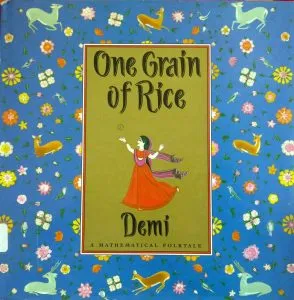
Last week my son’s third-grade class performed a school play, One Grain of Rice. We had read the book the previous summer as I had heard it was a great book that teaches math. Just check out the Amazon Reviews – have you seen anything so highly rated?

Before I explain the story, I will warn you that this article is going to contain spoilers. If you are a parent reading this hopefully you can live with a spoiled book for elementary-age kids.

The story of One Grain of Rice is simple. A humble peasant does a good deed for the ruling figure and asks for one grain of rice doubled every day for several weeks or a few months. I generalized that because my son’s school play version had some differences from the book version. The good deed, ruler, and time of the grain of rice doubling were different.

The ruler grants the peasant’s request for the doubled grains of rice. Around 20 days he starts to regret the decision as he has to give over a million grains of rice away. Eventually, the peasant becomes the town hero with all the wealth to spread through the town.

Try One Grain of Rice On a Spreadsheet With Your Kids

I found this project with a spreadsheet. I originally found it as a great summary of the story itself, but it’s a great kid-friendly introduction to spreadsheets.

If you get used to using the spreadsheet it will be useful when you try to model one grain of rice with money:

One Grain of Rice With Money

Taking the lesson of One Grain of Rice and applying it to money isn’t a stretch. In the story, rice is essentially the kingdom’s form of currency. (It makes more sense than using bees as currency)

It would be nice if we could double our money every day, but there’s not an investment in the world that would do that. Instead, you may choose to explain that it’s reasonably possible to double your money every 6 years or so. Some parents out there might be familiar with the Rule of 72. The Rule of 72 states that money doubles every X years depending on the growth percentage. For example, if you are earning 5% interest, it will take about 14 years for your money to double – (72 divided by 5 is about 14 years). If you can earn 12% interest, it will only take 6 years for your money to double – (72 divided by 12 is about 6 years).

Assuming a 12% interest rate over the long haul may stretch reality a bit. The stock market has returned that much for long periods, but it’s far from a guarantee. It’s more of an exception than the norm. We’re looking to motivate kids with the power of investing, so you may want to focus on the sunnier side. You also may want to create your own Bank of Dad where you can afford to pay higher guaranteed interest rates (at least for a little while).

You may want to run a few scenarios with your kids. Using that “money doubles every six years” you could find that you have 5 or 6 doubling events by the time they are mom and dad’s age. By that time, a dollar invested at their age might be $32. One hundred dollars would be $3,200. You can blow their minds by going to 10 doubling events in 60 years when a dollar is worth over $1000. Of course, they might not care because it’s hard for kids to imagine a 68-year-old version of themselves.

Brian MacFarland has reached more than 10 million people on his personal finance journey to financial independence.  He’s been featured in the Washington Post, U.S. News and World Report, and Lifehacker.

Read more on the About page.

If you enjoyed this article please Support Kid Wealth

Win a Free Teen Entrepreneur Course ($197 Value)

The Simple Startup

To celebrate six months of Kid Wealth, I’m giving away a course to teach your tween/teen how to start a business. This isn’t just any course. It’s by Rob Phelan of The Simple Startup. I’ve mentioned Rob a few times on this website. He’s the author of M is For Money and he’s the creator of the high school curriculum for The Choose Fi Foundation.

He’s a high school personal finance teacher and a Certified Financial Education Instructor by NCFE. Anyone can create a course, but very few people can say they’ve helped kids launch dozens and dozens of income-producing businesses.

If your kid has ever said, “I want that!” but didn’t have the money to buy it, this course is for them. The Simple Startup comes in two flavors. There’s a self-guided course. Then there’s the Summer Group Challenge. The Summer Group Challenge is a 6-week interactive course. It has live webinars twice a week – a great way to keep kids motivated and accountable. It also ensures that if they get stuck, they’ll have a hand. The Summer Group Challenge is normally $197, but one Kid Wealth reader will win one for free.

By the way, your odds of winning are very good since Kid Wealth is new. Also, everyone who enters will receive a consolation prize!

Enter with the widget below or click here

Brian MacFarland has reached more than 10 million people on his personal finance journey to financial independence.  He’s been featured in the Washington Post, U.S. News and World Report, and Lifehacker.

Read more on the About page.

If you enjoyed this article please Support Kid Wealth

Week’s Best from Kid Wealth (#3)

It’s time for another week’s best. Usually, I like to highlight different happenings around the kid financial literacy space. Today, I’d like to take a deeper dive into just one aspect of kid financial literacy. It may be the most aspect.

High School Financial Literacy Courses

More and more states are requiring students have some kind of financial literacy course to graduate high school. This CNBC article suggests that Georgia and South Carolina will be requiring financial literacy soon. There are a lot of politics dividing the United States lately. One area that seems to get bipartisan agreement is kid financial literacy.

It’s almost shocking that it took everyone so long to get on board. My only thought is that everyone always knew that kid financial literacy was important – they just had other education priorities. Obviously, I’m a fan of kids learning this important skill.

I’m going to ask you to stay with me on this next one. It’s useful for everyone here in any state, even though I’m focusing on one.

Rhode Island Financial Literacy

The news of the week was actually in my neck of the woods – Rhode Island. Last June, a law was signed here to create, develop, and approve academic standards “for the instruction of consumer education in public high schools.” As part of this, schools have to create courses and require “all students demonstrate
proficiency in consumer education prior to graduating high school.”

The actually “weekly news” is that Rhode Island launched a Financial Literacy Resource Page… and it’s awesome!

For example, with the high-school literacy outline, there are links to resources that are “non-commercial, research-based, standards-aligned, and include teacher training, instructional materials, and assessments.”

It’s quite literally everything that you might ever need to teach kids financial literacy. The only thing that’s missing is that awesome teacher to make it fun and interesting. There’s nothing specific to Rhode Island in many of the resources. There’s even a financial literacy proficiency quiz. I took the demo and it isn’t easy.

What do you think? Is my Rhode Island tax money being put to good use? (I think so.) Can you take advantage of those tax dollars even if you aren’t in Rhode Island? (Quite possibly.)

Brian MacFarland has reached more than 10 million people on his personal finance journey to financial independence.  He’s been featured in the Washington Post, U.S. News and World Report, and Lifehacker.

Read more on the About page.

If you enjoyed this article please Support Kid Wealth

Three Kid-Motivating Business-Starting Ideas

Kid Start Business Ideas

Have your kids ever come to you and said, “I want to buy a Nintendo Switch?” It may not be a Nintendo Switch, but it could be an Xbox, a new bike, or even a bunch of Roblox Robux. Sometimes an allowance isn’t enough. When kids want expensive things, this is a good time to get them interested in starting a business.

My kids are busy with every after-school activity under the sun. We haven’t jumped into starting a business yet. They are only 8 and 9 so we’ve got some time. This summer they have several day camps, but we have one week where none of the camps worked out. For that week, I’ll likely be doing some homeschooling, which will include some financial literacy and perhaps planning to start a business.

If you are looking to do the same, here are some ideas to get your kid motivated to start a business.

Bonus Idea: A couple of weeks I shared a business idea of making can tab bracelets. I got some feedback that it is a great idea.

Brian MacFarland has reached more than 10 million people on his personal finance journey to financial independence.  He’s been featured in the Washington Post, U.S. News and World Report, and Lifehacker.

Read more on the About page.

If you enjoyed this article please Support Kid Wealth